
Stairs are the hardest-working floor in any home. Every trip up and down puts weight on the same spot, and the front edge of each step (the nosing) takes the most of it. That’s why a carpet that looks perfect in a bedroom can look tired on a staircase within a couple of years.
Why stairs need a different carpet
On a flat floor, wear spreads out. On stairs, it’s concentrated on a small area of each tread, and the carpet is bent tightly over the nosing, which opens up the pile. A carpet for stairs needs to:
- Spring back after being walked on, so it doesn’t flatten into a worn path.
- Stay tight over the edge of each step without the backing showing through.
- Hide everyday marks, because stairs are hard to keep spotless.
- Be safe underfoot, firm and not too thick or slippery.
Which pile type is best?
Twist pile: the best all-rounder
Twist carpets have cut fibres that are tightly twisted, which makes them springy and hard-wearing, and they hide footprints well. For most staircases, this is what we recommend first. Cormar Hampstead and the Cormar 50/50 range are both popular twist choices for stairs.
Loop pile: tough, but choose carefully
Loop carpets such as Abingdon Berber are very durable and have a lovely natural texture. On stairs, there are two things to watch: loops can be snagged by pets’ claws, and on some loop carpets the backing can show where the carpet bends over the nosing (fitters call this “grinning”). Ask to bend the sample over a step edge before you decide.
Velvet and saxony: luxurious, but they show wear
Velvet-pile carpets like Victoria Royal Velvet look and feel wonderful, but they show footprints and shading, and on stairs that shows most on the nosings. They’re best in bedrooms or on stairs that don’t see heavy family traffic.
Wool, wool-rich or synthetic?
| Good for stairs because… | Watch out for… | |
|---|---|---|
| Wool & wool-rich (e.g. 80/20) | Springs back well, keeps its look for years, naturally soft and warm. | Costs more. Some stains need prompt attention. |
| Wool blends (e.g. 50/50) | A balance of wool’s feel and synthetic toughness at a lower price. | Not quite as resilient as wool-rich. |
| Polypropylene | Affordable and very stain-resistant. Many can be cleaned with a diluted bleach solution (check the label), which suits busy homes and rentals. | Can flatten faster on heavy-use stairs, so choose a dense one. |
| Nylon | Very resilient and hard-wearing for its price. | Quality varies a lot, so compare density. |
Density matters more than thickness. Push your fingers into a sample: if you can easily feel the backing, the pile is loose and will flatten. A short, tightly packed pile will outlast a long, fluffy one on stairs every time.
Choosing a colour that lasts
Very light carpets show dirt quickly on stairs. Very dark ones show dust, fluff and pet hair. The colours that stay looking good longest are mid-tones, heathered or flecked carpets, and subtle patterns, which hide everyday marks. If you love a light colour, a runner with a darker border, or a stain-resistant synthetic, makes it much more practical.
Underlay and fitting styles
A good, firm underlay is essential on stairs. It protects the carpet where it bends over each nosing and makes it last longer. A very soft, spongy underlay may feel nice on a landing but lets the carpet move and wear on the step edges.
There are two main ways to fit carpet on stairs:
- Waterfall: the carpet goes over the nosing and drops straight down to the next tread. Quick to fit and a classic finish.
- Hollywood (upholstered): the carpet is wrapped tightly around each nosing and follows the riser. It looks crisper and more tailored, and takes a little longer to fit.
We’ll show you both when we measure, and tell you which suits your carpet and your stairs.
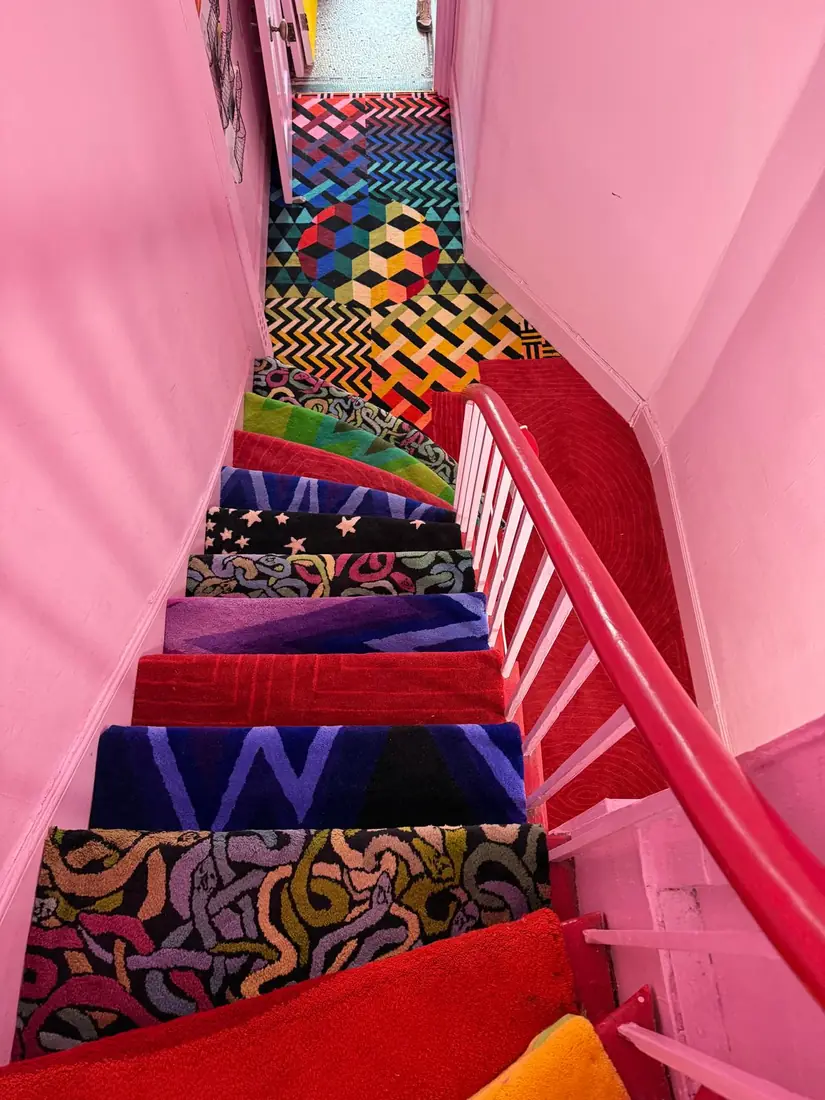
Stair runners: when they’re the better choice
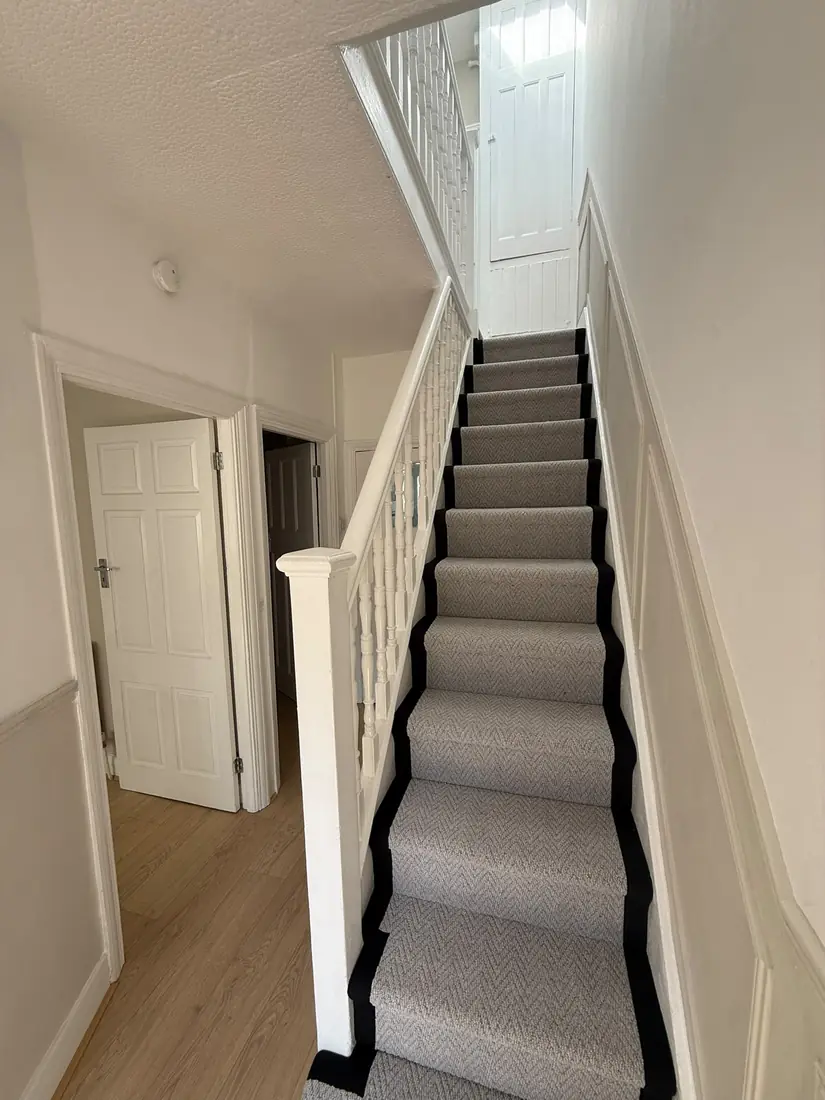
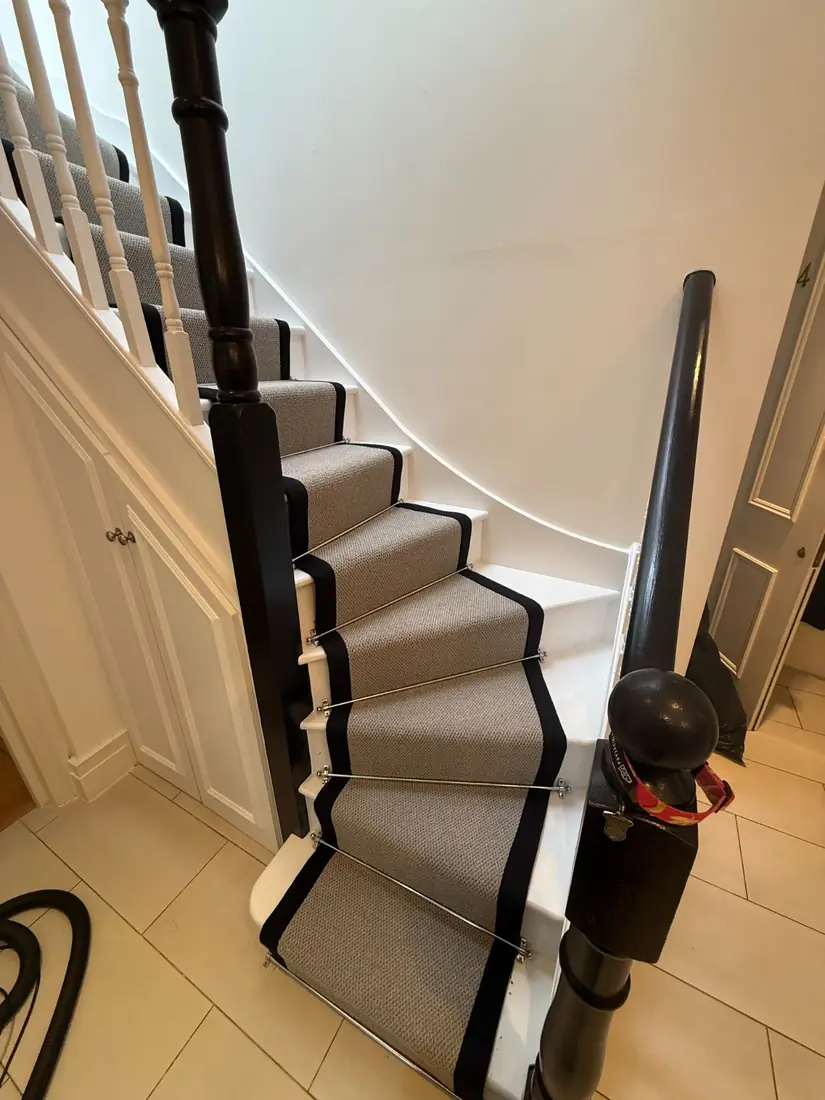
A stair runner is a strip of carpet down the middle of the stairs, leaving the painted or wooden edges on show. In many Victorian and Edwardian London houses, it’s the look the staircase was made for. A runner is a good idea if:
- your stairs are timber in good condition, or you’re happy to paint the edges;
- you want a period or designer look, with bound edges in a contrasting colour, or with stair rods;
- you’d like something easier to replace later, as only the runner needs changing.
A full stair carpet is usually better if your stairs are plain softwood in poor condition, or if warmth and quietness are the priority. Either way, the runner or carpet is made to measure for your staircase, including landings and any winding steps.
What affects the cost of a stair carpet?
The main things are the carpet you choose, how many steps there are, whether there are winders (the angled steps on a turning staircase) or landings, the fitting style, and for runners, the edge binding. Taking up and disposing of the old carpet also goes into the quote.
Because every staircase is different, we measure first and then give you a free, clear written quote, with no surprises on the day.
Our verdict
For a busy family staircase, a dense twist pile in a wool-rich blend or quality synthetic, in a mid-tone or flecked colour, over a firm underlay, will look good for years. For a period house with good timber stairs, a bound stair runner is hard to beat. To see the options on your own stairs, book a free home measure and we’ll bring samples to you, or call us on 02034902346, 7 days a week. You can also browse our recent stair work.
Questions we get asked
What is the most hard-wearing carpet for stairs?
A dense twist pile is the most reliable all-rounder for stairs. A wool-rich blend such as 80/20 wool and synthetic springs back well and keeps its look, while good-quality synthetic carpets are very hard-wearing and easy to clean. Density matters more than thickness: a short, tightly packed pile outlasts a long, loose one.
Is loop pile carpet good for stairs?
It can be, but take care. Loop pile is tough, but loops can be pulled by pets’ claws, and on some loop carpets the backing can show through where the carpet bends over the edge of the step (fitters call this ‘grinning’). If you love the look, ask to see how the sample bends over a stair edge before you choose.
What is the difference between a waterfall and a Hollywood stair fitting?
With a waterfall fitting, the carpet goes over the edge of the step and drops straight down to the next tread, leaving a small gap under the nosing. With a Hollywood (or upholstered) fitting, the carpet is wrapped tightly around the nosing and follows the shape of the riser. Hollywood looks neater and more tailored but takes longer to fit.
Is a stair runner a good idea?
A runner suits houses with timber stairs in good condition, especially period homes, where the painted or wooden edges are part of the look. It’s also easy to replace if it wears. If your stairs are plain softwood in poor condition, or you want maximum warmth and quiet, a full stair carpet is usually the better choice.
Do you fit stair carpets and runners across London?
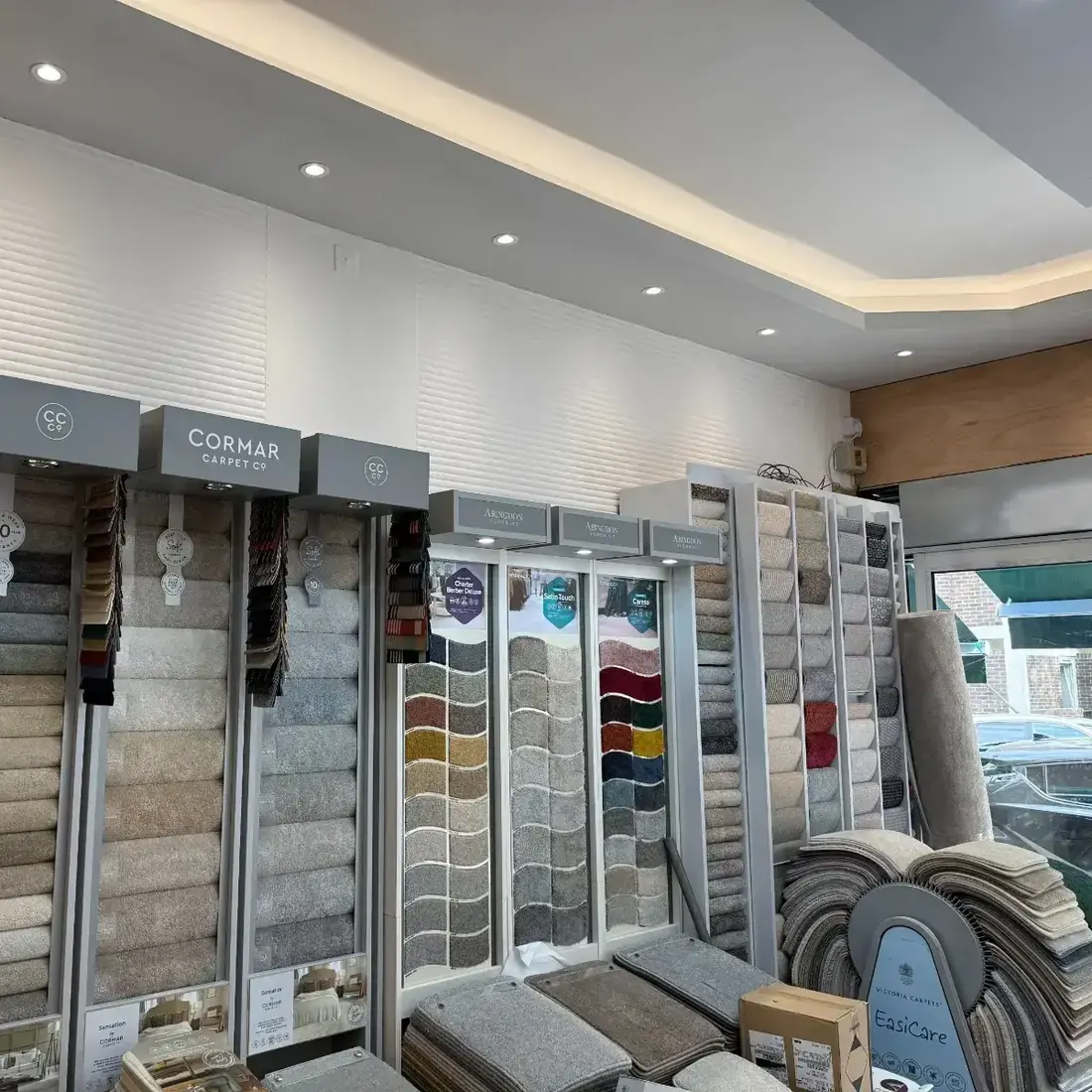
Yes. Stairs and runners are a big part of our work. We measure for free, bring samples to you, and give a clear written quote. You can also see our ranges in our showroom on Bourne Terrace, W2, open 7 days a week from 9am to 5pm.